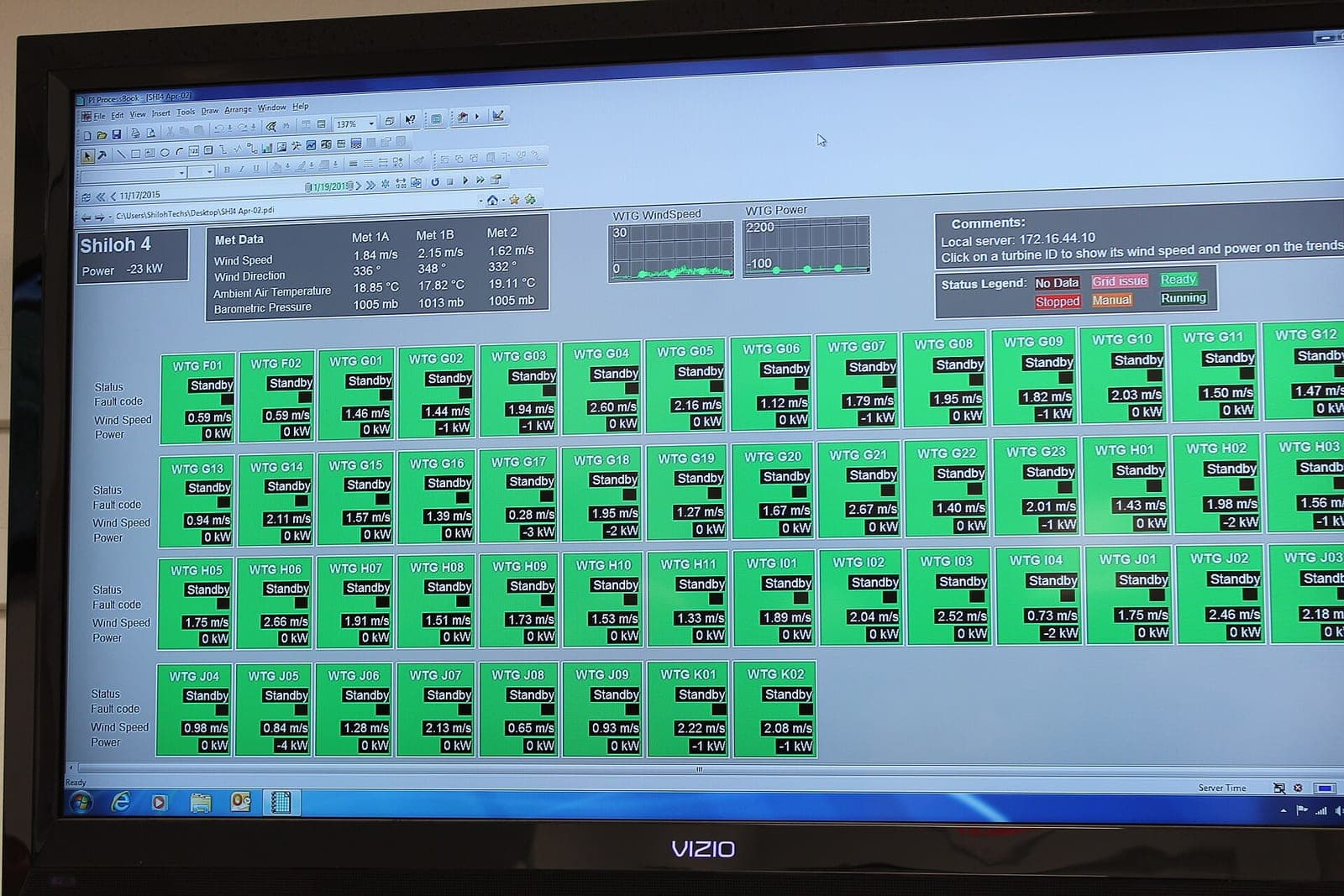

What is SCADA? Components and use in energy facilities
SCADA collects data from devices spread across a site or region and lets you monitor and control them from one place. It combines field devices, RTU/PLCs, communications, an HMI and a database.
Request a demoRenokta Ekibi ·
- 1. Field devicesSensors and meters measure quantities such as current, voltage and temperature.
- 2. RTU / PLCField signals are collected, pre-processed and prepared for the center.
- 3. CommunicationsData travels to the center over wired or wireless links.
- 4. HMI and alarmsThe operator sees values on a diagram, and threshold breaches raise alarms.
- 5. DatabaseMeasurements and events are stored with timestamps and support reporting.
SCADA (Supervisory Control and Data Acquisition) is a monitoring and supervisory system that collects measurements from remote or widely spread equipment, shows them in a central location and, when needed, sends commands back to the equipment. It is common in facilities that cover a large area, such as power plants, substations, and water and gas networks.
What components make up a SCADA system?
A SCADA system typically has five layers: field devices, field controllers, a communication network, a monitoring interface and a database. Each layer passes the data it receives up to the next one.
- Field devices: sensors, meters, relays and transducers that measure quantities such as current, voltage, temperature or position, or that operate an output.
- RTU and PLC: collect field signals, pre-process them and forward them to the center; a PLC can also run local control logic.
- Communications: wired (serial, Ethernet, fiber) or wireless (cellular, radio) links that carry the data to the center.
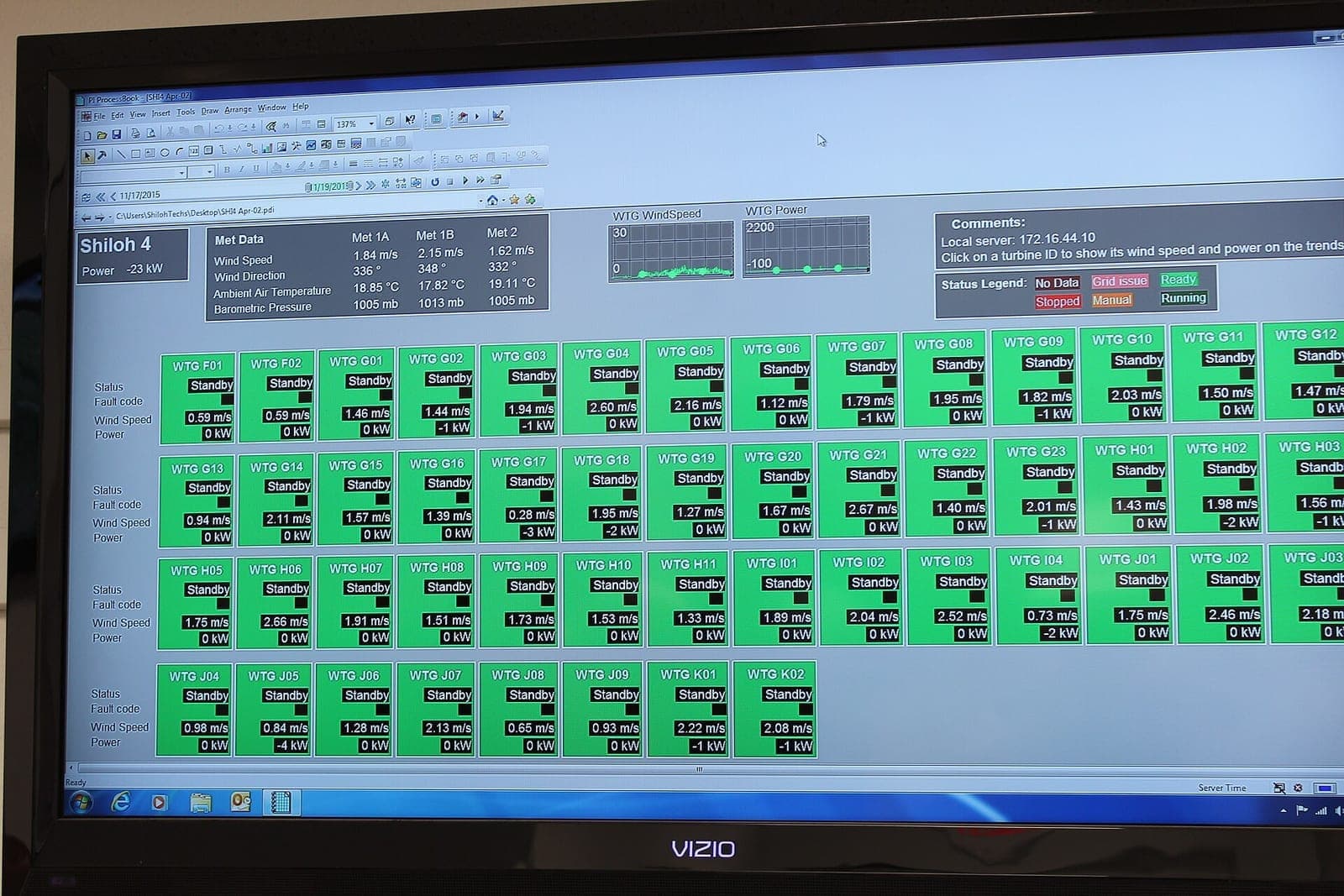
- HMI and monitoring software: the interface where an operator sees the plant through diagrams, alarm lists and trend charts.
- Database: the record layer that stores past measurements, alarms and events and underpins reporting.
What is the difference between an RTU and a PLC?
An RTU is designed to gather data at remote points and talk to a control center, while a PLC is mainly used for local process control. In practice the two classes have converged, and many devices can do both jobs.
RTUs are usually built with harsh field conditions and intermittent, low-bandwidth links in mind. PLCs excel at fast-cycle control logic. The choice depends on how widely the site is spread and how much local control is needed.
How does SCADA monitor a site from a central point?
A central server polls the field controllers at set intervals and reads their values. The values update on HMI screens, quantities that cross a threshold raise alarms, and all data is written to a database with a timestamp.
Protocols such as Modbus, DNP3 and IEC 60870-5-104 are common in industrial communication, and IEC 61850 is also used for substation automation. Which one fits depends on what the devices support and on the existing infrastructure.
Alarms are also an important part of this flow. A well-designed alarm list records not only what went wrong but when it started and what the operator acknowledged. These records are valuable later during fault analysis.
What is SCADA used for in energy facilities?
In energy facilities, SCADA shows the live state of generation and consumption points, helps spot faults quickly and allows analysis on recorded data. The use cases vary with the type of facility.
- Solar and wind plants: inverter and meter data and weather measurements on a single screen.
- Substations and distribution: breaker states, line currents and alarm events.
- Industrial sites: consumption from main and sub-meters, plus capacitor bank and panel status.
- Cogeneration and boiler rooms: process quantities such as temperature, pressure and flow.
How does classic SCADA differ from cloud-based monitoring?
Classic SCADA runs on the operator's own network and usually covers control as well, whereas cloud-based monitoring sends measurements over the internet to a platform and focuses on visualization and reporting. The two often complement each other rather than compete.
Critical control can stay on the local network while management reports and multi-site comparisons run in the cloud layer. Which data leaves the network should be decided up front, together with cybersecurity and company policy.
What should you consider when starting a SCADA project?
Start by defining what will be monitored and which decision the data will support. Writing down the point list, communication path, alarm rules and retention period at the start reduces later changes.
- The list of points and data types to be measured.
- The protocols supported by existing devices.
- What happens to data when communication drops (local buffering, resend).
- Security rules such as user permissions and network segregation.
SCADA is a basic tool for visibility in energy facilities, and its value depends on measuring the right points and tying the data to decisions. To assess the monitoring needs of your facility, see our energy SCADA and automation solution page or get in touch for a needs discovery.
Frequently asked questions
- What does SCADA stand for?
- SCADA stands for Supervisory Control and Data Acquisition. It is a monitoring and supervisory system that collects data from remote equipment, displays it centrally and can send commands back when needed.
- Is SCADA the same as a PLC?
- No. A PLC is a device that controls equipment in the field, while SCADA is the higher-level system that gathers data from many PLCs and RTUs for central monitoring. A PLC can sit in SCADA's field layer.
- Is SCADA only for large facilities?
- No. Its value grows with scale, but small and mid-sized facilities can also use it for monitoring and alarms. Scope depends on the number of points to measure and the level of control required.
- Which protocols does SCADA use to collect data?
- Common protocols include Modbus, DNP3 and IEC 60870-5-104, and IEC 61850 is also used in substation automation. The choice depends on what the field devices support and on the communication infrastructure.
- Can SCADA and cloud monitoring be used together?
- Yes. Control can stay on the local SCADA network while selected measurements are sent to a cloud platform for reporting. Which data leaves the site should be decided with security and company policy in mind.